
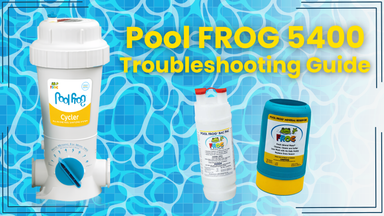
Pool FROG 5400 Troubleshooting Guide: Common Problems and Fixes
Published by Anthony on 04/29/2026
Posted in: Chlorine Alternatives
Most Pool FROG 5400 issues come down to five fundamentals: water balance, circulation, chlorine delivery, correct dial adjustment, and a properly sealed cycler. Start with the safety steps below, then use the symptom table to identify the likely cause and fix.
The Pool FROG 5400 is an in-line mineral sanitizer for pools from 7,000 to 40,000 gallons. It uses a Mineral Reservoir together with a Pool FROG Bac Pac chlorine cartridge, with a typical operating free-chlorine range of 0.5–1.0 ppm.
Safety First
Never open the Pool FROG cycler under pressure. Turn off the pump, follow the manufacturer’s pressure-relief procedure, and stand back when opening the cap to allow fumes to dissipate. Keep return-line valves open during normal operation to prevent gas-pressure buildup.
Do not put fast-dissolving chlorine tablets, liquid bleach, calcium hypochlorite, bulk chlorine, or shock products inside the Pool FROG cycler. Use only compatible Pool FROG components—including the Mineral Reservoir, Bac Pac, and FROG BAM—in the unit. Add shock directly to the pool according to its label, never through the skimmer or cycler.
If the cycler body or cap is cracked, degraded, or visibly damaged, replace the affected component rather than attempting to operate it under pressure.
Quick Diagnostic Checklist
Before changing dial settings or replacing parts, work through these basics:
- Test water chemistry. Aim for pH 7.2–7.8, total alkalinity 80–120 ppm, calcium hardness 200–400 ppm, stabilizer 20–80 ppm, total dissolved solids below 1,500 ppm, and free chlorine 0.5–1.0 ppm.
- Confirm circulation. Circulate the full pool volume one to two times daily. For many pools, that means roughly 8–12 hours of pump operation, though actual run time depends on your pool size, pump, and flow rate. A dirty filter, clogged skimmer, or full pump basket can reduce flow and impair sanitizer delivery.
- Inspect the consumables. Confirm that the Mineral Reservoir is present and within its service life. Confirm that the Bac Pac is properly seated and still contains tablets in its tower areas.
- Check the dial and re-test patiently. Make only small changes, then test again after 24 hours. Start with ½-increment changes whenever possible; if chlorine remains very low, increase gradually rather than making a large adjustment all at once.
- Look for air or pressure problems. Air bubbles in the pump basket or return jet can signal a suction-side leak. Insufficient back pressure can contribute to under-chlorination, while excessive back pressure can contribute to over-chlorination.
Common Problems and Fixes
| Symptom | Likely causes | Practical fixes |
|---|---|---|
| Free chlorine is below 0.5 ppm | Empty or improperly installed Bac Pac; dial too low; inadequate circulation; low back pressure; air leak; heavy swimmer load or organic contamination | Verify tablets are in the Bac Pac towers and the pac is seated correctly. Raise the dial incrementally, re-test after 24 hours, and shock if chlorine has remained below 0.5 ppm for more than one day. Ensure adequate pump run time, clean filtration, and proper flow. |
| Free chlorine is above 3.0 ppm | Dial too high; excess pump run time; excessive back pressure; loose or missing pressure-relief valve | Remove the Bac Pac and test daily until chlorine falls to about 1.0 ppm. Reinstall it, lower the dial by one setting, and re-test after 24 hours. If needed, reduce unnecessary circulation time and have a pool professional check back pressure. |
| Water is cloudy | Dirty filter; insufficient circulation; poor water balance; low sanitizer; organic buildup | Clean the filter, skimmer, and pump basket; increase circulation if needed; balance the water; shock to remove organic contaminants; and maintain the recommended free-chlorine level. |
| Green water or algae | Early algae growth; low chlorine; inadequate circulation; dirty filter | Shock the pool, clean the filter, brush pool surfaces, and increase circulation if necessary. Use an appropriate algaecide or FROG BAM only as directed. |
| Water turns brown, yellow, rusty, or another unusual color | Oxidized metals in fill water; developing algae; water-balance issue | Have the water tested for metals such as iron or copper. Clean the filter, shock as appropriate, and use a suitable metal-control product if testing confirms a metal issue. |
| Cycler cap leaks or is hard to remove | Dry, flattened, damaged, dirty, or improperly seated cap O-ring; cracked cap; cross-threading | Turn off the pump and depressurize before servicing. Remove debris, inspect the O-ring and cap, lubricate the O-ring with silicone lubricant only, and replace damaged parts. Do not use petroleum-based lubricants. |
| Chlorine stays low with a variable-speed pump | Pump runs at low speed only or spends too little time at high speed; trapped air in the cycler | Run the pump at high speed long enough for adequate flow through the cycler. With the pump running, loosen the cap knob until water appears, then retighten it to release trapped air. Repeat after every cap removal if needed. |
| Dial will not turn or setting seems wrong | Mineral residue, scale, worn control-dial O-rings, damaged dial, or incorrect adjustment method | Use the handle end of the supplied cap/control-dial tool if the dial is difficult to turn. Do not force it. If the dial or O-rings are worn, replace them according to the cycler service instructions. |
| Bac Pac seems to empty too fast | Dial set too high; very long pump operation; higher-than-normal pool demand; pressure or flow issue | Check free chlorine first. If it is high, lower the setting and reassess run time. Cartridge life varies with pool size, water temperature, swimmer load, and circulation schedule. |
| Cap or cycler develops cracks | UV exposure, age, overtightening, freeze damage, physical impact, or chemical exposure | Do not operate a damaged cycler under pressure. Replace cracked components and make sure the unit is winterized correctly at season’s end. |
Detailed Fixes
Low chlorine or no sanitizer reading
A low free-chlorine reading is one of the most common Pool FROG 5400 complaints. Begin by confirming that the Bac Pac is installed correctly and contains chlorine tablets in both tower areas. If it is empty, replace it with the compatible Pool FROG Bac Pac. The Mineral Reservoir should also be current and replaced according to its service schedule.
If the consumables are correct:
- Test water balance, especially pH, alkalinity, and stabilizer.
- Clean the filter and baskets so the cycler receives adequate water flow.
- Raise the control dial gradually and test again after 24 hours.
- Shock the pool if chlorine has been below the recommended range for more than one day.
- Check for air bubbles at the pump basket or return fittings, which may indicate a suction-side air leak.
- Ask a pool professional to test cycler back pressure if the problem continues.
With a variable-speed pump, low-speed operation can limit proper cycler performance. Run the pump at a higher speed for enough time each day to create adequate flow through the system. If needed, bleed trapped air from the cycler by loosening the cap knob until water appears, then retightening it.
High chlorine reading
If free chlorine rises above 3.0 ppm, remove the Bac Pac from the Mineral Reservoir and test the water daily until chlorine falls to approximately 1.0 ppm. Then reinstall the Bac Pac, lower the dial by one setting, and re-test after 24 hours. Repeat as needed, one setting at a time.
If chlorine remains excessive even at the minimum setting, investigate the following:
- Pump circulation time may be longer than necessary.
- Back pressure may be too high.
- The internal pressure-relief valve may be loose, missing, or damaged.
- The dial may be set higher than intended or may need replacement.
Avoid making large, rapid dial changes. Small adjustments and regular water testing are the best way to find a stable setting for your pool.
Cloudy, discolored, or green water
A cycler cannot compensate for poor circulation or neglected water balance. For cloudy water, start by cleaning the filter, emptying the skimmer and pump baskets, checking circulation time, balancing the water, and shocking to remove accumulated organic material.
If the pool is green or algae is forming:
- Brush the walls, floor, corners, ladders, and steps.
- Clean or backwash the filter as appropriate.
- Shock the water and increase circulation if needed.
- Use a suitable algaecide or FROG BAM according to label directions.
- Continue testing chlorine and water balance until the pool is clear.
If water becomes brown, rusty, yellow, or otherwise unusual after filling or adding water, consider dissolved metals. Iron and copper can oxidize and discolor pool water. Have the water professionally tested before choosing a metal-control treatment.
Cap, O-Ring, and Leak Fixes
The Pool FROG 5400 cap seal depends on a clean, flexible O-ring. Every time you open the cycler, inspect the O-ring for cuts, flattening, cracks, swelling, grit, or loss of elasticity. Lubricate it periodically with silicone lubricant made for pool-equipment O-rings. Never use petroleum-based lubricant.
To replace a cap O-ring:
- Turn off the pump and fully relieve pressure from the cycler.
- Remove the existing O-ring from the cap groove.
- Clean the cap groove and remove all debris.
- Seat the new O-ring evenly in the groove without twisting or stretching it.
- Apply a light coating of approved silicone lubricant if recommended.
- Thread the cap on straight and tighten it by hand.
Do not overtighten the cap, force it onto damaged threads, or use tools to tighten it. If the cap is cracked, warped, difficult to thread, or unable to maintain a seal, replace the cap assembly.
For a compatible replacement option, EZ Pool & Spa Supply carries the genuine Pool Frog Cap With O-Ring, 01-22-9417 for the relevant Pool FROG and related King Technology in-ground cycler families. Confirm your exact model and part number before ordering.
When to Call a Professional
Contact a pool professional or equipment manufacturer support if:
- The cycler body, cap, plumbing, control dial, or fittings are cracked, heavily degraded, or leaking under pressure.
- You cannot keep chlorine within range after completing the basic checks.
- The system’s back pressure needs testing or return-line modifications may be needed.
- You suspect a suction-side plumbing leak.
- The system is installed with an in-floor cleaner, pool/spa combination, unusually high flow, or other specialized plumbing.
- You are unsure whether the Pool FROG 5400 is installed in the proper location after the filter and heater.
Regular testing, clean filtration, steady circulation, careful dial adjustments, and prompt replacement of worn O-rings or caps will resolve many Pool FROG 5400 performance issues before they become bigger pool-care problems.